Tuesday, February 9, 2010

THE WORRY BOX


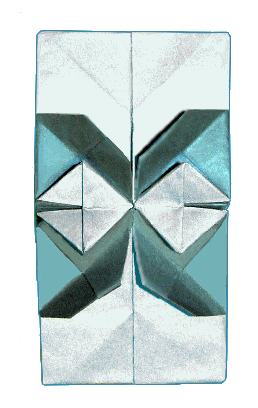
This box was made as a gift for a friend. It is made from letterhead paper which is 8.5 by 11 inches. The back of the paper is red. The front of the paper is white with a black and white striped border surrounded by a red pin stripe.

I used a standard Tomoko Fuse design but modified the lid in order to make the best use of the pattern. The rim is folded over several times and appears on the outside of the box. Unfortunately I could not line up the stripes at the diagonal fold on the sides.

Sunday, February 7, 2010

THE CORNER WINGED BOX


This series has side wings or wrap arounds as corner shapers.

The first in the series has truncated diamonds on the outside of the box and the tips turned into the box to prevent the wings from flying outwards. If you like the wings popping outwards then make the box without turning the top hem over and into the inside of the box. The side wings are folded from to the left and the edges of the top diamond wraps around it on the left and turns under freely on the right.

A variation has the top turned out as a rim and the internal wings halved and squashed across the edge seams. The covering truncated diamond cannot tuck into the underlying diamond in this version.


The next version turns half the diamond into the box and converts the turned over edge into triangles in the middle of the sides which are turned outwards.


THE BOAT BOX

A variation folds these triangles to look like a sail boat.


Tuesday, February 2, 2010

DECORATIVE MODULAR RING


Carrying on from yesterday's paper connection model I created a modular ring. There are two sections, which differ only in the finishing pattern of the center twist. The orange module overlaps the brown module at both ends.


Monday, February 1, 2010

THE WATCHBAND RING


I have been experimenting with modular paper connection again. This time I aimed to make a long ribbon of connected pieces of paper which could be used as a ring, bangle, belt, napkin holder, or similar.

I have called the
model The Watchband because the decorations on the front resemble the links of the standard metal watchband.

The green and blue model was folded from standard 6 inch kami squares which were folded into quarters in both directions and then cropped to produce 4 x 3 rectangles. This provides enough paper to ensure that inside is relatively smooth and can be worn as a ring or bracelet without irritating the wearer.

The original model, shown here in white, is folded from 2 x 1 rectangles.
The advantage of this version is that the model is less bulky and folds neatly from thicker paper. The model shown is folded from 4 x 2 inch pieces of copy paper. The disadvantage of this sized paper is that the back side of the model is bumpy and is uncomfortable on the skin if worn as a ring or bracelet. Of course, this problem might go away if it were also folded from thinner paper. Alternatively, the band can be worn inside out, with the link pattern on the inside and the diamonds showing on the front.

Crease Patterns for both the original 4 x 4 and the 4 x 3 (Variation 2) model are shown here. A third option, Variation 1, will produce a model with pointed bumps around the edges.


Saturday, January 30, 2010

ROSITA'S STAR


I have been working on several kusudamas lately. More about them when they are completed. The problem with kusudamas is that they can take a long time to complete, especially when they have 60 or more pieces. So I get bored and fiddle with other foldings. This is one such fiddle.

I am not sure whether this is an original creation or whether someone else has discovered it already. It is not particularly completed, as stars go, although there are a couple of surprise moves towards the end.

The pink star is made from 20 lb copy paper. The two images show the front and the back.


The photos featuring blue paper are a rather messy step fold sequence which may provide the reader with enough information to help them try out the star on their own.


1. Begin by folding a square in half lengthwise and diagonally. Turn the paper over.


2. Halve the angles.


3. Collapse the creases to form diamonds, as shown.


4. Turn to a face with a full diamond. Fold the sides in to the center at the top. Repeat on the four faces showing a full diamond.


5. Unfold and collapse these creases inwards.


6. Turn to a face with a truncated diamond. Fold the bottom tip up to the top edge of the partial diamond. Fold the bottom part in half again. Repeat on each of the four faces.

7. Collapse upwards and inwards.


8. Turn to a face with the flat top. Crease the right side of the bottom section as shown. Repeat on the four faces.

9. Gently push the model flat. Ease the creased sections down.

10. Slowly fold down the remaining four flaps, easing them so that they sit flat and are equidistant between the contiguous folded sections.

Enjoy!

Wednesday, January 20, 2010

THE DECO TOP BOX


This box is made from two or three squares of paper: one for the decorative lid and one or two for the base.


The base has two versions. The plain version has the hem turned inwards, folding from left to right. The decorative version has the hem folded outwards and tucked under to form triangular projections on the corners.

The two versions can be combined by slipping the plain version under the triangle projections.

The plain base, which is folded inwards, is made from a square which is about a quarter inch smaller than the lid, depending on paper size and thickness. The decorative base, which is folded outwards, is made from a square which is about a half inch smaller than the lid. For the combined version the plain version is made from a square which is the same size as the decorative version. That is, both versions are made from squares about a half inch smaller than the lid. This allows the plain base to slip over the white part and under the corner triangles of the decorative base.


Here are the crease patterns.


There are no folding diagrams at this time.

Tuesday, December 1, 2009

THE SERENDITY BOX AND LID


Here is a box which began life as an attempt to follow someone's verbal instructions for making a vase. I never did figure it out but was satisfied with the box which I created along the way. Since I began the experiment several days ago, it has been through several variations and ended up with a couple of lids .

The yellow box is version three. It begins life as a square which is pre-folded into quarters. The outside eighth is divided into thirds by the simple expedient of folding the edge in towards the next crease until it looks to be about half way. It is reasonably accurate, if you are careful to check the corners to see that the edges line up.


Version four is folded from a square which has been pre-creased into thirds. In one of the early blogs on this site you will find the URL for a convenient division helper template. It uses the parallel lines trick.

The nice thing about the thirds version is that corner ends which are tucked in around the box in a clockwise direction are lined up well enough to give the impression that the edging is braided all the way around. It is, in fact, an illusion.

Once the sides have been rolled over and the end strips formed, collapse the model into a preliminary base. This will push up the overlapped ends until they form a long point. These points will be tucked into the adjoining side in a clockwise direction.

The slanted sides of the box are found by lining the base of the V on the pointed corner end strip with the middle crease on the side panel. Line up the V and push the piece flat to form a slanted side. You can minimize the creasing by rolling the stip a little before bending it. The wall crease should begin from the pre-crease line below it. In the thirds version you will not need to fold the base up after forming the wall slants as the edge coincides exactly with this pre-creases. However, a little bit of extra creasing at this point helps the final assembly stage.

Unfold the creased flap and move to the next side.

Once all four sides have been creased go around the model again, tucking in each end strip and creasing the tips in line with the slanting crease from the next side panel. Un-tuck and proceed to the next section.

Once this has been done tuck the ends in all the way around and leave them there. The last strip will have to eased over the bend of the adjoining wall.

Finally flatten the floor, firm up the base of the box and gently push the tucked-in strips up as far as they will go. {They slip down a little during construction.}


The first lid is very easy to fold. It is basically a variant of the windmill base. The top square is a little larger than the top entry of the box. In order to lock the box the corner tips (yes, them again) are folded under the lid and then folded back on themselves. I estimate this distance and you can too. Just make sure that the line is parallel.

Finally, put the lid on top of the box and tuck the tips into the corner pockets around the top of the box.

The second lid is almost identical except for the addition of a halving fold which allow the underside of the paper to be seen.

Emjoy!